






13 May, 2025
Sections
Law on the Military Ombudsman and the Rights of Servicemembers
Event
On May 8, two draft laws initiated by the President of Ukraine were registered in the Verkhovna Rada: № 13266 “On the Military Ombudsman” (hereinafter – Draft Law 1), and № 13267 “On Amendments to the Criminal Code of Ukraine and the Code of Ukraine on Administrative Offenses Concerning the Activities of the Military Ombudsman” (hereinafter – Draft Law 2).
These legislative proposals aim to establish the legal status, mandate, and organizational framework of the Military Ombudsman. According to the drafts, the Military Ombudsman would serve as an official through whom the President of Ukraine, pursuant to Article 106 of the Constitution and Articles 4 and 5 of the Law of Ukraine “On National Security of Ukraine”, exercises democratic civilian oversight of the security and defense sector with respect to ensuring the rights of servicemembers by the military authorities and commanders.
CPLR’s assessment
According to Draft Law 1, the Military Ombudsman’s role in protecting the rights of servicemembers is intended to complement existing mechanisms for safeguarding constitutional rights and freedoms. Servicemembers will retain the right to seek protection of their rights, freedoms, and lawful interests through the courts, relevant state authorities, and other entities. This includes procedures established by the Civil Procedure Code, the Criminal Procedure Code, the Code of Administrative Procedure of Ukraine, the Law “On Citizens’ Appeals”, and the Disciplinary Statute of the Armed Forces of Ukraine (hereinafter – DSAFU).
The key responsibilities of the Military Ombudsman include:
- exercising democratic civilian oversight over the observance of the rights of servicemembers by military authorities and commanders;
- identifying the causes causes and conditions that lead to violations of servicemembers’ rights, and developing proposals to minimize or eliminate them;
- preparing analytical reports and relevant recommendations.
The outcomes of the second and third of mentioned tasks are expected only in the relatively long term. To fulfill the first task – exercising democratic civilian oversight – it is proposed to grant the Military Ombudsman the authority to consider complaints (Section IV) and conduct inspections (Section V of Draft Law 1). Under certain conditions, these measures could provide meaningful and timely support to servicemembers in defending their rights.
Проте, на заваді виконанню цього завдання можуть стати такі проблеми.
1. According to paragraphs 110–111 of the DSAFU, servicemembers are entitled to file complaints to officials, military command authorities, law enforcement agencies, pre-trial investigation bodies, and other state institutions in the following cases:
- when unlawful decisions, actions, or omissions by commanders (superiors) or other servicemembers violate their rights, lawful interests, or freedoms;
- when they are unlawfully assigned duties or subjected to unjust prosecution measures.
Complaints on other service-related matters must be submitted to the immediate commander (superior) of the individual whose actions are being contested. If the complainant is unaware of who is responsible for the alleged violation, the complaint must be submitted through the subordination chain.
Thus, Draft Law 1 does not clearly outline the specific circumstances under which servicemembers should file complaints in accordance with this Law, and in which cases they should follow the procedure outlined in the DSAFU. In other words, it is unclear which specific rights violations of servicemembers would justify the initiating of inspections within Part 2 of Article 15 of Draft Law 1.
Therefore, it may be necessary to clarify in all relevant provisions of Draft Law 1 that only violations of servicemembers’ rights, freedoms, and legitimate interests committed by their direct commanders (superiors) should be addressed, where appealing under the DSAFU procedure would be clearly mimingless.
In this regard, cl. 110 of the DSAFU should specify that a servicemember cannot file a complaint under this Statute if it concerns the actions (inaction) or decisions of their direct commander (superior), where there are reasonable grounds to believe that an objective or impartial resolution of the complaint by another commander through the subordination chain is impossible. In such cases, the servicemember should submit the complaint to the Military Ombudsman, the court, or file a statement with a law enforcement agency or prosecutor.
2. According to Article 13 of Draft Law 1, the provisions of the Law of Ukraine “On Citizens’ Appeals” shall not apply to complaints submitted to the Military Ombudsman. Similarly, the Law of Ukraine “On Administrative Procedure” (Article 1) specifies that its provisions do not apply to relationships arising during military service.
However, Draft Law 1 fails to define the following important aspects:
- the deadline for submitting complaints and the consequences of failing to meet it;
- the rights of individuals during the review of their complaints, and what individuals can demand in their complaints;
- the procedure for registering a complaint and the procedure for its processing;
- the duties of the Military Ombudsman and their authorized representatives when considering complaints;
- compensation for damages resulting from violations of legal requirements during the complaint review process;
- other related matters (by analogy) that are defined in detail in Articles 16-19, 25 of the Law of Ukraine “On Citizens’ Appeals” and Articles 78-85 of the Law of Ukraine “On Administrative Procedure”.
3. The draft Law 1 establishes that the activities of the Military Ombudsman, including the consideration of complaints, do not entail altering the authority of state bodies responsible for protecting and restoring violated rights and freedoms.
However, it does not specify (except in cases where the issues raised in the complaint are already under judicial consideration) how the Military Ombudsman should make decisions on complaints in situations where a servicemember seeks protection of their violated rights under multiple procedures simultaneously, such as those outlined by the DSAFU, this Law, or other legislative acts.
4. According to the Draft Law-1, the procedure for reviewing a complaint, conducting an investigation, preparing a conclusion, and its subsequent review by a commander may take up to four months (including 10 working days for reviewing complaint , 60 working days for the investigation, and 30 working days for considering the conclusion) or even longer when accounting for weekends and time required for send documents.
Therefore, it is obvious that mere presence of “reasonable grounds” (Part 1, Article 16) or a “reasonable request” (Part 4, Article 18) is insufficient to justify extending the prescribed timelines. Draft Law 1 should explicitly outline the specific circumstances under which these time limits may be extended, as well as situations in which they should be shortened.
The overall timeframe appears especially excessive when compared to the deadlines for investigations in criminal proceedings. For example, in cases where an individual is notified of suspicion of committing a criminal offense, the investigation must be completed within 72 hours. If the suspect denies guilt or further investigative (detective) actions are required, the period may extend to 20 days. In cases involving suspicion of a crime, the investigation must be completed within two months.
5. Part 4 of Article 14 of Draft Law 1 provides that if a complaint contains indications of a criminal offense, the relevant law enforcement authorities must be notified. However, this does not mean the possibility of the alleged offender also being held disciplinarily liable, as Article 61 of the Constitution of Ukraine establishes that disciplinary and criminal liability are not mutually exclusive. To avoid ambiguity, the draft law should explicitly state that notification of law enforcement agencies occurs in parallel with the consideration of the complaint and, if necessary, the conduct of an internal investigation.
6. Article 21 of Draft Law 1 requires that the Military Ombudsman’s annual report include, among other things, information on the provision of clarifications, methodological assistance, and consultations. However, the draft articles outlining the Ombudsman’s powers do not authorize the provision of such clarifications or assistance. Furthermore, Part 3 of Article 14 specifies that complaints seeking legal interpretation or opinions on the application of Ukrainian law are not subject to review.
7. Articles 17 and 19 of Draft Law-1 grant the authority, during inspections, to obtain written explanations from individuals, request and receive specific information, and conduct site visits not only to the Military Ombudsman but also to their deputies and other authorized representatives. However, Draft Law-2 proposes establishing liability only for failure to comply with the lawful demands of the Military Ombudsman or for obstructing the Ombudsman in the exercise of their powers. This approach significantly weakens the legal status of the Ombudsman’s deputies and other authorized representatives.
Yet Another Draft Law on AWOL Does Not Address the AWOL Issue
Event
On May 5, Draft Law “On Amendments to the Criminal and Criminal Procedure Codes of Ukraine Regarding Liability for Criminal Offenses Related to Unauthorized Abandonment of a Military Unit or Place of Service Under Martial Law” № 13260 (hereinafter – the Draft Law) developed by the Ministry of Defense of Ukraine, was registered in the Verkhovna Rada. The Draft Law proposes the following:
- to repeal Part 5 of Article 401 of the Criminal Code of Ukraine (hereinafter – the CC), which currently provides for exemption from criminal liability for a servicemember who, for the first time during martial law, commits an offense under Articles 407 or 408 of the CC, provided that: a) the servicemember voluntarily submits a petition to an investigator, prosecutor, or court declaring intention to return to his/her place of service and resume military duties; and b) there is written consent from the commander (head) of the military unit (institution) (hereinafter – commander) for the servicemember to continue military service. [This provision was introduced into Article 401 by the Law of August 20, 2024];
- to supplement the Final and Transitional Provisions of the CC with a new cl. 24, which introduces a similar ground for exemption from criminal liability for a first-time offense of the same nature, provided that the servicemember: a) voluntarily returns to his/her assigned place of service; and b) continues performing military duties for at least three months (or, regardless of duration, in the event of the lifting or termination of martial law, or discharge from service due to health reasons). This ground would remain in effect until the new Law enters into force, if adopted.
CPLR’s assessment
This Draft Law does not adequately address the issue of unauthorized abandonment of a military unit or other place of service, or desertion by servicemembers (hereinafter referred to as AWOL (absence without leave).
Firstly, the Draft Law is intended to be temporary in nature. Even if it is swiftly adopted and comes into force, for example, on July 1, 2025, it would not apply to servicemembers who commit AWOL after that date. Consequently, a new law would need to be developed and adopted if cases of AWOL continue to occur on a large scale, making it practically impossible to prosecute all offenders. It must be reminded, that more than 70,000 criminal offenses under Articles 407 and 408 of the Criminal Code were recorded by prosecution authorities between January and April 2025 alone, while nearly 90,000 such offenses were recorded throughout 2024.
In this context, it would be advisable to supplement the CC with the permanent provision (e.g., Article 49-1), which would allow for exemption from criminal liability for first-time offenses of unauthorized abandonment of a place of service (Article 407 of the CC), desertion (Article 408), evasion of military duties by other means (Article 409), or evasion of conscription during mobilization or under a special period (Article 336), provided that the individual: a) voluntarily appears to fulfill his/her duty at the place of service, a territorial military authority, or a law enforcement/prosecutor’s office before being officially notified of suspicion; and b) immediately resumes or begins performing military service duties for a minimum of two or three months, with official confirmation from the commander of the military unit (or the head of the institution).
Secondly, contrary to the current CC, the Draft Law neither proposes amendments to the CC that would make the commander’s consent to the possibility of continuing military service by the suspect or defendant a condition for exemption from criminal liability, nor does it include a corresponding reference to the Criminal Procedure Code of Ukraine (hereinafter – CPC). However, amendments to the Transitional Provisions of the CPC provide that such commander’s consent is mandatory. This creates a conflict between two laws, which, in practice, may block the implementation of the CC provisions. If the commander does not grant consent, it will be impossible to fulfill the requirements of paragraph 1, cl. 24 of the Final and Transitional Provisions of the CC.
Thirdly, the Draft Law does not address the existence of numerous cases in which servicemembers who are AWOL are not actively sought and are still officially recorded as continuing military service. In particular, commanders exploit this loophole to unlawfully seize financial rewards and other benefits intended for servicemembers. The existence of such a scheme clearly diminishes commanders’ incentive to provide the aforementioned consent.
The draft law contains other legal inconsistencies.
Fourthly, the proposed amendments to cl. 20-10 of the Transitional Provisions of the CPC (final paragraph) state that if a court closes a criminal case and exempts a suspect or defendant from criminal liability under paragraph 1 of cl. 24 of Section II of the Final and Transitional Provisions of the CC, the court must issue a ruling requiring the released individual to report to the relevant military unit or place of service within 72 hours of the ruling taking legal effect. In this case the commander is obligated to reinstate the individual to military service on the day of his/her arrival.
However, this provision directly contradicts the condition for exemption from criminal liability outlined in paragraph 1 of cl. 24 of the Final and Transitional Provisions of the CC, according to which a serviceman is already performing military service for at least three months (or for a different period in the event martial law is lifted or terminated, or the individual is discharged due to health reasons).
Fifthly, according to the proposed amendments to cl. 20-10 of the Transitional Provisions of the CPC, the prosecutor or the court is required to obtain two documents: 1) written consent from the commander confirming that the individual is permitted to continue military service (paragraph 2); 2) document from the commander certifying the date and time of the individual’s voluntary return to their place of service and the duration of his/her service following return (paragraph 4).
However, paragraph 5 of the same provision provides that the prosecutor must attach only one of the above documents to the motion for release from criminal liability. It is unclear whether the decision on which document to submit rests with the prosecutor, the commander, or the court.
This inconsistency is likely to result in significant bureaucratic confusion in practice and may be exploited for corrupt purposes.
Draft Law № 13150: an Unsuccessful “Twin” of Draft Law № 4298
Event
On May 13, 2025, the Verkhovna Rada of Ukraine adopted as a basis the draft law “On Amendments to Certain Legislative Acts of Ukraine Regarding Ensuring Legality in the Activities of Local Self-Government Bodies and Their Officials” (Reg. № 13150, dated April 3, 2025). This initiative is intended to replace draft law № 4298 and accelerate progress on the indicator “Entry into force of legislation on reforming of the territorial organization of executive authorities in Ukraine”. This indicator is part of Reform 1: “Advance the Decentralization Reform” within the “Decentralization and Regional Policy” chapter of the Ukraine Facility 2024–2027 Plan.
Draft law № 4298, which proposes the transformation of local state administrations into prefecture-type bodies, had reached the final stages of preparation and was expected to be adopted in the first quarter of this year. However, this did not occur. The relevant parliamentary committee never considered the latest version of the draft due to unresolved issues on several critical points and substantial objections from key stakeholders.
To sidestep the adoption of draft law №4298, Members of Parliament introduced several alternatives, but ultimately flawed versions: draft laws №13124, №13150, and №13150-1. In our view, only draft law №13150-2 deserved support, as it was based on draft law №4298 and preserved its core conceptual framework. However, MPs decided to support draft law №13150.
CPLR’s assessment
Draft law №13150 is viewed as a simplified, superficial, and not always correct interpretation of several approaches outlined in draft law № 4298. Its most significant flaw lies in its proposal to strengthen the influence of local state administrations over local self-government bodies. Such an approach several lead to a loss of legal subjectivity of local self-government bodies. Legality would be ensured through state control. In our view, the use of the term “control” in this context is inappropriate; the term “oversight” would be more accurate.
Another shortcoming of draft law № 13150 is its failure to designate district state administrations as agencies charged with ensuring legality. Instead, these functions would be concentrated within regional state administrations, which will dangerously enhance their role compared to other local authorities.
The next shortcoming is the provision allowing local self-government bodies to adopt acts containing information with restricted access. This contradicts the Law of Ukraine “On Local Self-Governance in Ukraine” which neither permits nor provides for such a provision.
Moreover, the powers granted to local state administrations under draft law № 13150 concerning ensuring legality within the activities of territorial bodies of ministries and other central executive authorities indicate an attempt to reinforce the “sectoral” nature of local state administrations, rather than facilitate their transformation into prefecture-type institutions.
Overall, draft law № 13150 fails to ensure the transfomation of local state administrations into prefecture-type bodies. Although the reform of local state administrations is not limited solely to ensuring the legality of acts adopted by local self-government bodies, this draft law does not address other key aspects of the reform.
CPLR experts recommend replacing the term “control” with “oversight” during the preparation of draft law № 13150 for the second reading, in the context of ensuring legality of acts adopted by local self-government bodies. It is also advisable to empower district state administrations with the authority to ensure the legality of acts adopted by village, urban village, city, and city district councils, as well as their executive bodies.
Was this article helpful?


Analytics

13 Nov, 2025
Weekly analysis for 04 — 10 November
24 Sep, 2025
Weekly analysis for 16 — 22 September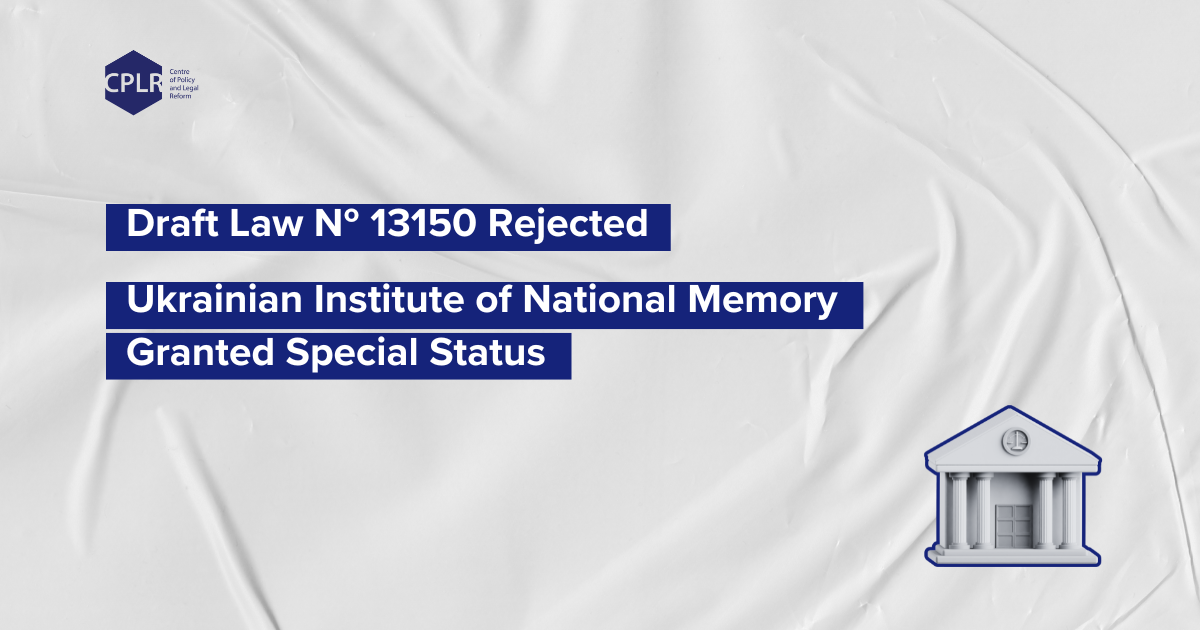
10 Sep, 2025
Weekly analysis for 02 — 08 September