





10 Oct, 2024
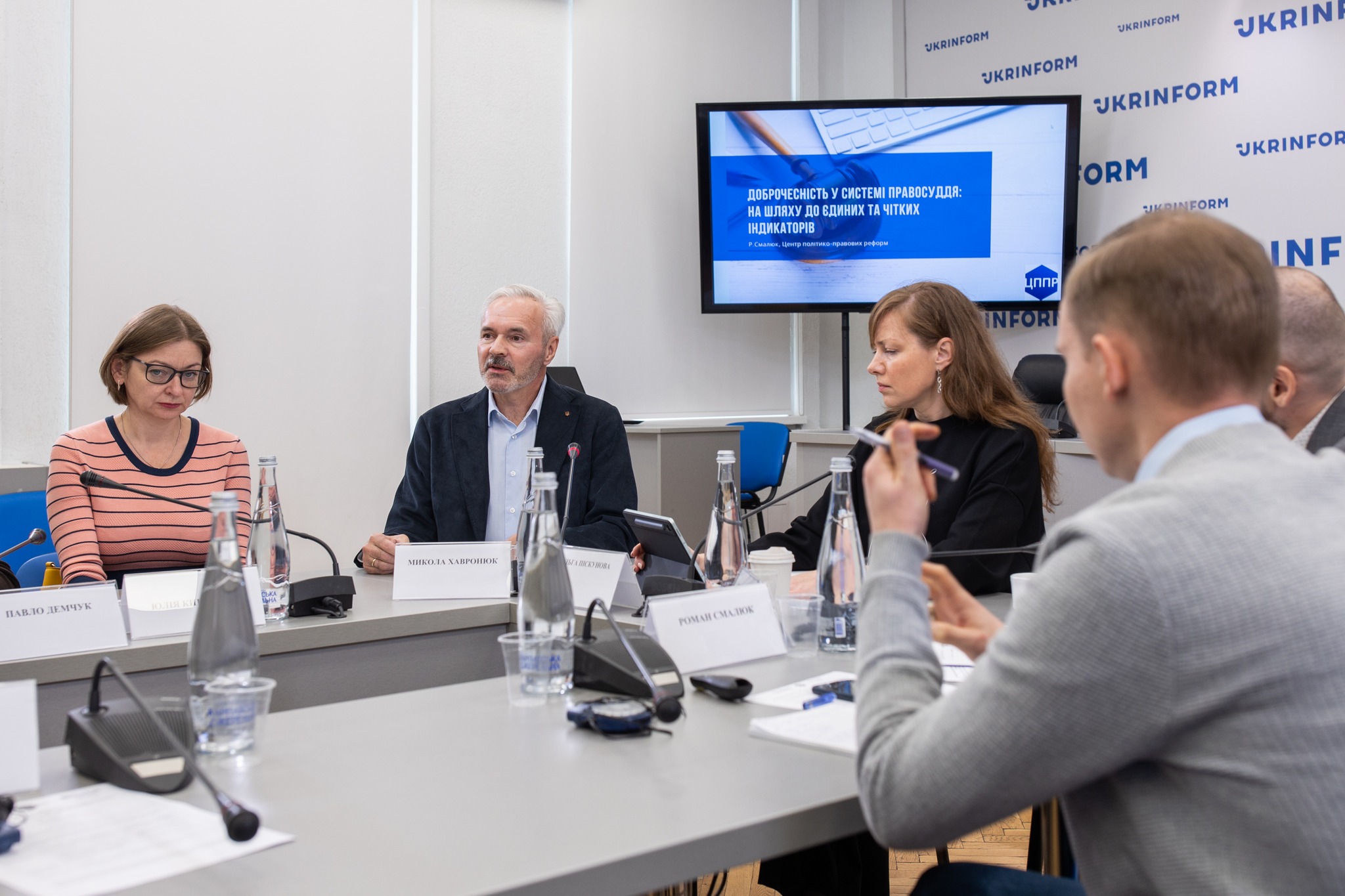
On October 10, an expert discussion “Integrity as a tool for assessing the professionalism of judges, prosecutors, and law enforcement officers: prospects for unifying approaches” was held, organized by the Centre of Policy and Legal Reform.
“Our criminal justice system has serious flaws, as many corruption cases take years and sometimes decades to resolve. The situation is exacerbated by the fact that disciplinary responsibility for certain categories of public officials is practically ineffective because of the lack of legal mechanisms to bring them to justice. We notice that for many individuals, there is no authority that could exercise oversight, which makes them de facto unreachable by justice. Even in cases where disciplinary sanctions are possible, their impact is insufficient. There is no doubt that such a situation needs to be changed”, stressed Mykola Khavroniuk, a member of the board of the Centre of Policy and Legal Reform.
The Centre of Policy and Legal Reform analyzed the practice of integrity assessment of judges, candidates for judicial positions, and members of the judicial self-governance bodies, as well as the disciplinary practices related to judges. Based on this analysis, an analytical report “Integrity in the Justice System: Towards Unified and Clear Indicators” was prepared this year. This report can be taken into account in the development of Unified Indicators for assessing the integrity and professional ethics of judges (or judicial candidates). Additionally, it could be applied in the future to extend integrity as a mandatory criterion for assessing candidates for prosecutor positions and law enforcement officers, particularly those in leadership roles.
Presenting the analytical report, Roman Smaliuk, the judiciary area lead at the CPLR, noted: “Defining integrity indicators at the regulatory level is an extremely challenging task. It is important to ensure that these indicators are not overly general, as this would create a risk of arbitrary interpretation by the authorized bodies, which could lead to potential abuses. At the same time, they should not be overly detailed, as there are many forms of unethical behavior that cannot be exhaustively described. Moreover, the list of such indicators cannot be exhaustive or static. The eight years of experience in integrity assessment provides valuable material that should be considered when developing these indicators”.
Despite integrity being one of the key criteria for the selection of judges and gaining increasing importance in competitive procedures for the prosecution and law enforcement agencies, there is no established approach to understanding the concept of “integrity”. However, there is an objective need to harmonize these approaches with the definition of integrity indicators, taking into account the specifics of each of these justice and law enforcement bodies.
“The issue of a unified approach to defining the integrity criteria in personnel decisions within law enforcement and prosecution bodies is becoming increasingly important. Today, state policy, particularly the Action Plan for the Comprehensive Strategic Plan for reforming law enforcement agencies, provides for the gradual expansion of competitive procedures in these bodies, as well as the strengthening of internal control mechanisms. Integrity is referenced throughout, yet it is understood differently by various agencies and departments. This is where the experience of assessing judges and the developed unified criteria can be valuable for further implementation of planned measures. Therefore, the Centre’s developments are important not only for judicial reform but also for criminal justice reform as a whole”, stated Yevhen Krapyvin, lead of the criminal justice area at the CPLR.
The discussion gathered leading stakeholders from the government and civil society sectors. Representatives from EUAM, TI Ukraine, IDLO, DEJURE Foundation, the HQCJ, the HCJ, the National Police, and the NACP joined the discussion in an in-person format. More than 30 participants joined and actively participated in the event online. The discussion was moderated by Olha Piskunova, an anti-corruption expert at the CPLR.
View the recording of the expert discussion.
Was this article helpful?


Projects related to the news
Донор
NDIBudget
149518 $
Implementation
September 15 2022 - February 28 2025
News


Experts blogs

Analytics